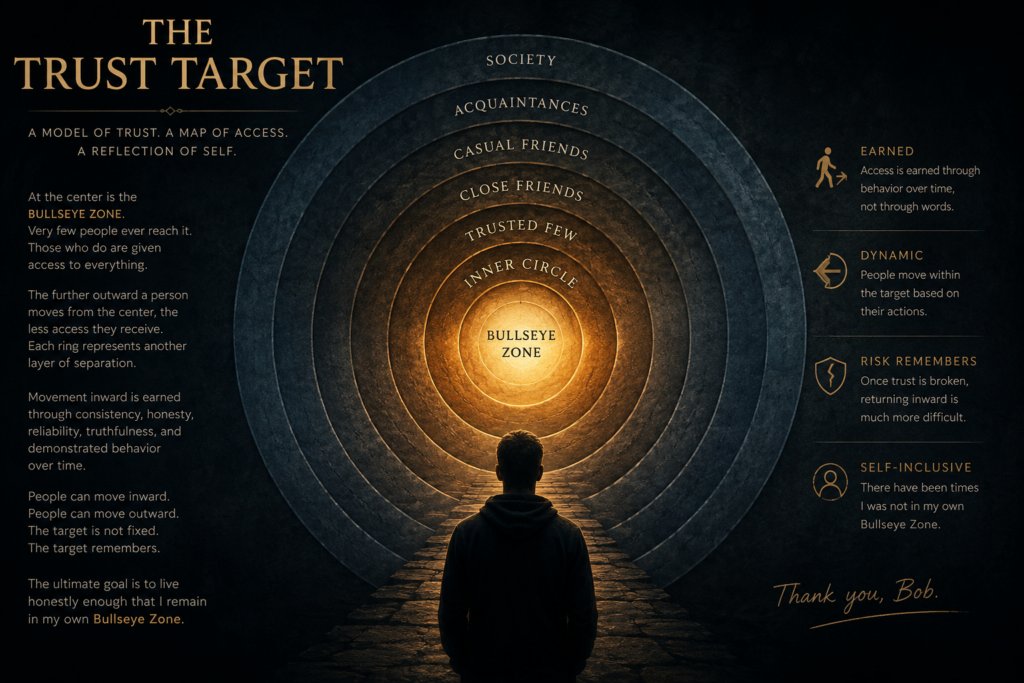
The Trust Target
I do not remember whether the Trust Target originated from a specific conversation with Bob or whether it emerged gradually from years of conversations, observations, and reflection. What I do know is that his influence is woven throughout the way I think about trust, honesty, relationships, and access to the deeper parts of a person. Whether he directly gave me this concept or helped create the conditions for it to emerge, he deserves some of the credit.
The Trust Target is exactly what it sounds like: a target.
At the center is what I call the Bullseye Zone. Very few people ever reach it. Those who do are given access to everything. There are no hidden chambers, no carefully managed narratives, and no significant barriers remaining between who I am and what they are allowed to see. They receive the full person—my history, my struggles, my failures, my hopes, my thoughts, my writing, my fears, and my dreams.
The further outward a person moves from the center, the less access they receive. Each ring represents another layer of separation. Most people exist somewhere within those outer rings. They may know pieces of me, but not all of me. They may know my opinions but not my wounds. They may know my story but not my deepest thoughts. They may know my name and little else.
At the very edge of the target is society itself. These are the people I encounter in everyday life. There is nothing wrong with remaining there. Most human interactions naturally exist at that distance.
The Trust Target is not fixed. People move within it constantly.
Movement inward is earned through consistency, honesty, reliability, truthfulness, and demonstrated behavior over time. Words may open a door, but behavior determines whether someone continues walking toward the center.
Likewise, people can move outward. Trust can weaken. Distance can grow. Access can be reduced. Relationships change, and the target changes with them.
One of the most important realities of the Trust Target is that trust can be rebuilt, but it is rarely reset.
When someone reaches an inner ring, they gain greater access to parts of me that are increasingly vulnerable. Because of that, they also gain a greater capacity to cause harm. If a person who has been trusted deeply breaks that trust, returning to their previous position becomes far more difficult. It is not necessarily because forgiveness is impossible. It is because risk has already been demonstrated.
The target remembers.
A stranger may have little ability to wound me because they have little access. Someone who has stood near the center has already been entrusted with things that matter.
Over time, I realized that the Trust Target applies to more than other people.
There have been periods of my life when I was not fully within my own Bullseye Zone.
There were times when I avoided truths about myself, refused to examine certain wounds, or lacked the courage to look directly at who I was becoming. In those moments, I possessed information about myself without possessing understanding. I knew things intellectually that I had not yet accepted emotionally.
The Trust Target is therefore not only a model of interpersonal trust. It is also a model of self-honesty.
The ultimate goal is not merely to place the right people in the right rings.
The ultimate goal is to live honestly enough that I remain in my own Bullseye Zone.
⁂ ⁂ ⁂ ⁂ ⁂ ⁂ ⁂ ⁂ ⁂